
The Hidden History of Databases: From Punch Cards to AI-Powered Data Systems
Discover the fascinating evolution of databases, from 19th-century punch cards and IBM's early innovations to SQL, NoSQL, cloud computing, and AI-powered vector databases. Learn how databases became the foundation of modern technology.
TECHNOLOGYDATADATABASESSOFTWARE ENGINEERING
1Knowledger Research Team
5/8/20244 min read
Every application you use today depends on a database.
Whether you're booking a flight, sending money online, shopping on an e-commerce website, or scrolling through social media, a database is working behind the scenes.
Yet most people never think about databases. Developers use them every day, businesses depend on them, and entire industries would collapse without them. They are among the most important inventions in modern computing.
But databases didn't begin with cloud servers or SQL.
Their story started more than two centuries ago.
The First Data Storage System
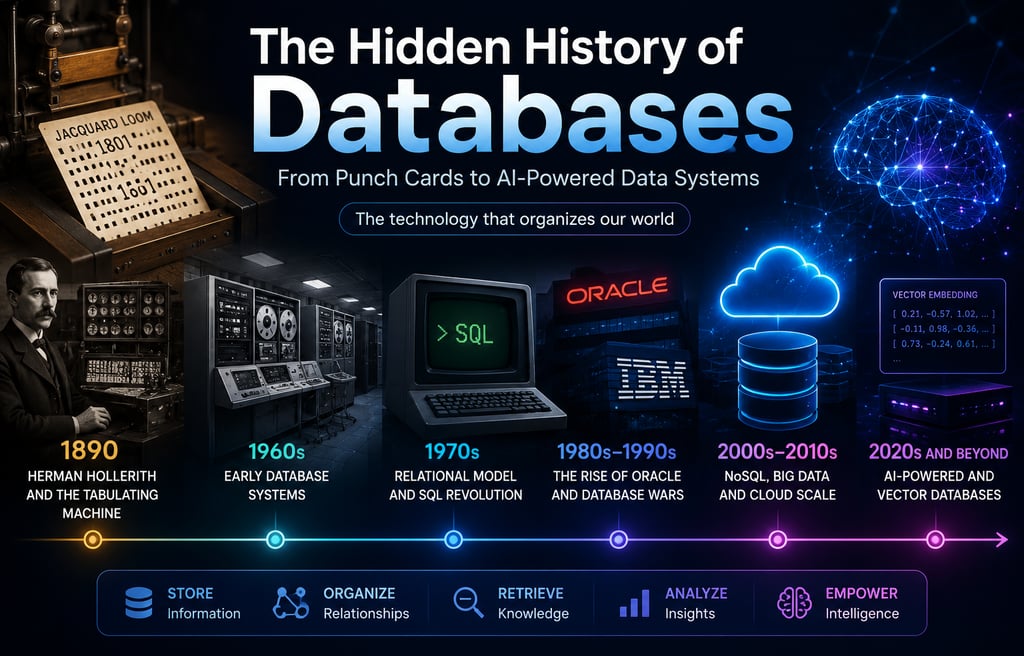
In 1801, French inventor Joseph Marie Jacquard introduced a revolutionary weaving machine that used punched cards to control textile patterns.
Each hole represented information. Each card stored instructions.
For the first time, machines could store and follow reusable data.
Although Jacquard was building looms rather than computers, he introduced a concept that would eventually become the foundation of digital information storage.
When Data Became a National Problem
By the late 1800s, the United States Census faced a serious challenge.
The population was growing so quickly that manually counting and processing census data could take nearly a decade.
By the time the results were completed, much of the information was already outdated.
A young inventor named Herman Hollerith developed an electromechanical system that stored census information on punched cards and processed it using machines.
The results were extraordinary.
The 1890 Census was completed in a fraction of the expected time, saving the government millions of dollars.
Hollerith's company would eventually evolve into one of the most influential technology companies in history: IBM.
The Problem With Early Data Systems
As businesses grew during the twentieth century, data volumes exploded.
Companies moved from punched cards to magnetic tapes and early computer systems.
But there was a major limitation.
Finding information was difficult.
Data was stored sequentially, meaning systems had to search through records one by one.
Retrieving a single customer record could take hours.
Organizations needed a better way to organize information.
The Birth of the Modern Database
During the 1960s, engineer Charles Bachman introduced the Integrated Data Store (IDS), one of the first true database management systems.
Instead of storing isolated records, IDS connected data through relationships.
Records could reference other records.
Information became interconnected.
This breakthrough introduced concepts that still influence database design today.
For the first time, data had structure.
How Databases Changed the Airline Industry
One of the most influential database projects in history was SABRE.
Developed by American Airlines and IBM, SABRE transformed airline reservations.
Before SABRE, booking a flight often required employees to search through physical records manually.
The process was slow, error-prone, and difficult to scale.
When SABRE launched in 1964, reservation times dropped from hours to seconds.
The system processed tens of thousands of bookings daily and demonstrated that databases could operate at massive scale.
But it also revealed an important truth.
Whoever controls data often controls the market.
Edgar Codd and the Relational Revolution
By 1970, database systems were becoming increasingly complex.
Programmers had to understand the exact path through the database to retrieve information.
Even small structural changes could break applications.
Then a British mathematician working at IBM proposed a radically different idea.
His name was Edgar F. Codd.
Instead of navigating through data manually, Codd suggested storing information in tables consisting of rows and columns.
Relationships would be defined logically rather than physically.
Most importantly, users could describe what information they wanted without specifying how to retrieve it.
This became known as the Relational Model.
Today, it is the foundation of nearly every modern business database.
The Rise of SQL
To make relational databases practical, researchers developed a new language called SQL (Structured Query Language).
SQL allowed users to ask questions using simple commands.
Examples include:
Finding customers
Retrieving sales reports
Generating financial summaries
Analyzing business performance
SQL transformed databases from specialist tools into systems that businesses could use at scale.
More than fifty years later, SQL remains one of the most valuable technical skills in the world.
Oracle, IBM, and the Database Wars
Although IBM invented much of the relational database technology, the company hesitated to commercialize it.
That hesitation created an opportunity.
A young entrepreneur named Larry Ellison recognized the potential.
His company launched Oracle, one of the first commercial relational database products.
Oracle's rapid growth forced IBM and other technology giants to accelerate their own database strategies.
The competition sparked decades of innovation and helped establish relational databases as the industry standard.
The Internet Changed Everything
The rise of the World Wide Web introduced new challenges.
Websites generated enormous volumes of information.
Images, videos, documents, and user-generated content did not fit neatly into traditional relational structures.
Companies such as Google, Amazon, and Facebook needed systems capable of handling unprecedented scale.
This led to the emergence of NoSQL databases.
Unlike traditional relational systems, NoSQL databases prioritized scalability, flexibility, and distributed architecture.
Technologies such as MongoDB, Cassandra, and DynamoDB became essential components of modern internet infrastructure.
The Era of Cloud Databases
Today, businesses no longer need to manage physical servers.
Cloud providers offer databases as services.
Developers can create applications that automatically scale across multiple regions and millions of users.
Popular cloud database platforms include:
Amazon DynamoDB
Google Firestore
Microsoft Cosmos DB
Infrastructure has become increasingly invisible.
Developers focus on building products while cloud platforms manage availability, backups, and scaling.
The Future: AI and Vector Databases
Artificial intelligence is creating the next major database revolution.
Traditional databases store facts.
Vector databases store meaning.
Platforms such as Pinecone and Milvus allow AI systems to search information based on similarity rather than exact matches.
This technology powers:
AI assistants
Semantic search
Recommendation engines
Retrieval-Augmented Generation (RAG)
Large Language Models
As AI adoption accelerates, vector databases are becoming a critical part of modern software architecture.
Why Databases Matter More Than Ever
Every day, humanity generates massive amounts of information.
Financial transactions.
Medical records.
GPS locations.
Business operations.
Artificial intelligence systems.
Behind all of it are databases.
They are no longer simple storage systems.
They are the invisible architecture of our digital civilization.
From punched cards in the nineteenth century to AI-powered vector databases in the twenty-first, the mission remains the same:
Organize information.
Transform chaos into structure.
Enable humans and machines to understand the world.
The history of databases is ultimately the history of how humanity learned to manage knowledge itself.
Contacts

Services
✔ Financial Records Review
✔ Cash Flow Review
✔ Financial Dashboards
✔ Monthly Financial Support
Financial intelligence for individuals and business who want clarity insight and growth.