
The Financial System Explained: How Money Moves Through the Global Economy
Discover how central banks, commercial banks, pension funds, hedge funds, investment banks, private equity firms, and venture capitalists work together to power the global economy.
FINANCEECONOMICSINVESTINGBUSINESSFINANCIAL EDUCATION
1Knowledger Research Team
5/8/20245 min read
Every day, billions of people wake up, go to work, earn money, pay bills, save for retirement, and invest for the future.
Most people think they understand money.
After all, they use it every day.
But very few people understand the system that moves, creates, and multiplies that money behind the scenes.
The truth is that modern finance is not simply about cash sitting in a bank account. It is a massive network of interconnected institutions that continuously move capital throughout the global economy.
Your paycheck might start at a company, pass through a commercial bank, contribute to a pension fund, get invested into a mutual fund, finance a startup through venture capital, and eventually return to the economy as jobs, products, and services.
This network is known as the financial system.
It is one of the most powerful and important systems ever created by humanity.
Without it, businesses could not grow, governments could not function, and economic progress would grind to a halt.
Understanding how this system works is essential for anyone interested in business, investing, accounting, economics, or personal finance.
What Is the Financial System?
The financial system is the collection of institutions, markets, regulations, and participants that facilitate the movement of money throughout an economy.
Its primary purpose is simple:
Move money from those who have excess capital to those who need capital.
In economics, these groups are often called:
Surplus Units
Deficit Units
Surplus units have more money than they currently need.
Examples include:
Savers
Pension funds
Insurance companies
Wealthy individuals
Corporations with excess cash
Deficit units need capital to achieve their goals.
Examples include:
Home buyers
Entrepreneurs
Businesses
Governments
The financial system acts as the bridge connecting these two groups.
Without this bridge, money would sit idle and economic growth would slow dramatically.
The Central Bank: The Puppet Master of the Economy
At the top of the financial system sits the central bank.
Most countries have one.
Examples include:
Federal Reserve (United States)
Bank of England (United Kingdom)
European Central Bank
People's Bank of China
Central banks do not serve everyday consumers.
Instead, they oversee the entire financial system.
Their primary objectives include:
Controlling inflation
Supporting employment
Maintaining financial stability
Managing the money supply
To achieve these goals, central banks use monetary policy.
One of their most powerful tools is interest rates.
When economic growth slows, central banks often lower interest rates.
Lower rates make borrowing cheaper.
Businesses invest more.
Consumers spend more.
Economic activity increases.
When inflation becomes excessive, central banks raise interest rates.
Higher rates make borrowing more expensive.
Spending decreases.
Economic activity cools down.
This constant balancing act helps stabilize the economy.
Because of their influence, central banks are often considered the most powerful financial institutions in the world.
Commercial Banks: The Engine of Economic Activity
While central banks manage the system, commercial banks operate within it.
These are the banks most people interact with daily.
Examples include:
JPMorgan Chase
Bank of America
Wells Fargo
HSBC
Barclays
Commercial banks perform several important functions:
Accept deposits
Provide loans
Process payments
Facilitate transactions
However, their most important role is connecting savers and borrowers.
When you deposit money into a bank, that money does not simply sit in a vault.
Banks use deposits to support lending activities.
Loans finance:
Homes
Businesses
Vehicles
Education
Commercial projects
This process allows money to circulate through the economy rather than remaining idle.
The lending system also expands economic activity and supports long-term growth.
Without commercial banks, modern economies would struggle to function efficiently.
Pension Funds: The Silent Giants
Most workers contribute to retirement plans throughout their careers.
What many people do not realize is that pension funds are among the largest investors in the world.
Collectively, pension funds manage tens of trillions of dollars.
Their mission is straightforward:
Ensure workers receive income after retirement.
To accomplish this, pension funds invest capital across numerous asset classes, including:
Stocks
Bonds
Real estate
Infrastructure
Private equity
Venture capital
Because pension funds invest over decades, they can provide enormous amounts of capital to financial markets.
Many of the world's largest infrastructure projects, commercial developments, and investment funds rely heavily on pension fund capital.
Although most people rarely think about them, pension funds play a critical role in the global economy.
Mutual Funds: Investing Made Accessible
Investing used to be difficult.
Building a diversified portfolio required significant capital and expertise.
Mutual funds changed that.
A mutual fund pools money from thousands of investors and invests it according to a specific strategy.
This approach provides several advantages:
Diversification
Professional management
Accessibility
Reduced risk
Instead of purchasing dozens or hundreds of individual securities, investors can buy shares in a single fund.
Large firms such as Vanguard, Fidelity, and BlackRock manage trillions of dollars through mutual funds.
These organizations help millions of individuals participate in financial markets without requiring advanced investment knowledge.
Hedge Funds: High Risk, High Reward
Hedge funds operate differently.
Unlike mutual funds, hedge funds generally serve wealthy individuals and institutional investors.
Their goal is not simply to match market performance.
Their goal is to outperform it.
To achieve this, hedge funds employ sophisticated strategies such as:
Short selling
Derivatives trading
Arbitrage
Quantitative investing
Global macro investing
Some hedge funds generate extraordinary returns.
Others fail spectacularly.
Because hedge funds often use leverage and complex financial instruments, they carry significantly higher risk.
Despite the risks, hedge funds remain influential participants in global financial markets.
Investment Banks: The Architects of Billion-Dollar Deals
Investment banks occupy a unique position within the financial system.
Rather than serving individual consumers, they focus on corporations, governments, and large institutions.
Major investment banks include:
Goldman Sachs
Morgan Stanley
Citigroup
UBS
Their responsibilities include:
Initial Public Offerings (IPOs)
Mergers and Acquisitions (M&A)
Capital Raising
Corporate Advisory Services
When a company wants to go public, an investment bank typically manages the process.
When a corporation wants to acquire a competitor, investment bankers help structure and negotiate the deal.
When governments need funding, investment banks often assist in issuing bonds.
In many ways, investment banks act as financial engineers, connecting capital with opportunity on a massive scale.
Private Equity: Buying and Transforming Businesses
Private equity firms specialize in acquiring companies.
Their objective is simple:
Buy businesses, improve them, and sell them for a profit.
Major private equity firms include:
Blackstone
KKR
Apollo
Carlyle Group
Private equity firms frequently use leveraged buyouts (LBOs), combining investor capital with borrowed money to acquire businesses.
Once acquired, the firms attempt to increase profitability through operational improvements, restructuring, or strategic growth initiatives.
Supporters argue that private equity creates more efficient businesses.
Critics argue that excessive debt and cost-cutting can harm companies.
Regardless of perspective, private equity has become one of the most influential forces in modern finance.
Insurance Companies: Managing Risk at Scale
Insurance companies perform a unique function.
They help individuals and businesses manage risk.
By collecting premiums from many policyholders, insurers can compensate the smaller percentage of customers who experience losses.
Insurance products include:
Health Insurance
Life Insurance
Auto Insurance
Property Insurance
Business Insurance
Because insurance companies collect large amounts of cash before paying claims, they accumulate enormous investment portfolios.
These funds are invested across:
Government bonds
Corporate bonds
Stocks
Real estate
Alternative investments
As a result, insurance companies are not only risk managers but also major institutional investors.
Venture Capital: Financing Innovation
Many of today's most successful technology companies began as small startups.
Building these companies required funding.
That funding often came from venture capital firms.
Venture capitalists invest in high-growth startups with the hope that a small number of investments will generate extraordinary returns.
This strategy follows a principle known as the Power Law.
Most startups fail.
A few succeed.
An even smaller number become transformational companies worth billions of dollars.
Examples include:
Facebook
Uber
Airbnb
Stripe
OpenAI
The success of a few major investments can generate returns large enough to offset numerous losses.
Venture capital plays a crucial role in technological innovation and economic growth.
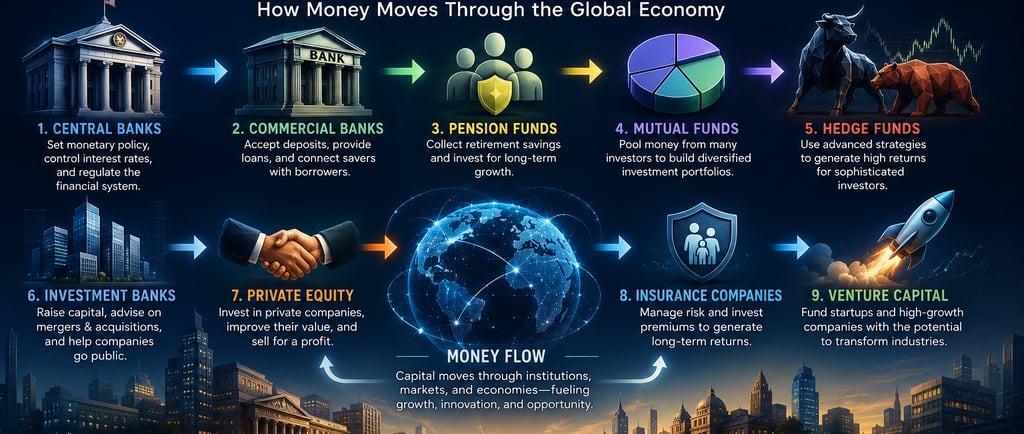
How Everything Connects
The financial system functions like a giant machine.
Each institution performs a specific role.
Central banks regulate the system.
Commercial banks facilitate lending.
Pension funds provide long-term capital.
Mutual funds democratize investing.
Hedge funds pursue higher returns.
Investment banks structure major transactions.
Private equity acquires and transforms businesses.
Insurance companies manage risk.
Venture capital funds innovation.
Together, these institutions create a continuous flow of money throughout the economy.
Every paycheck, loan, investment, premium payment, and business transaction contributes to this cycle.
Final Thoughts
The financial system is often invisible.
Most people interact with only a small portion of it.
Yet behind every financial decision lies a complex network of institutions working together to allocate capital, manage risk, and support economic growth.
Understanding how these organizations function provides valuable insight into how money truly moves through the world.
Whether you are an entrepreneur, investor, accountant, analyst, or simply someone interested in personal finance, learning how the financial system works can help you make better decisions and better understand the forces shaping the global economy.
The financial system is not merely a collection of banks and investment firms.
It is the engine that powers modern civilization.
Contacts

Services
✔ Financial Records Review
✔ Cash Flow Review
✔ Financial Dashboards
✔ Monthly Financial Support
Financial intelligence for individuals and business who want clarity insight and growth.